By Michael Hammer | Mike Hammer Moving
Grandfather Clock Movers: A Guide to Careful Tall Case Clock Relocation
Table of Contents
Key Takeaways
- Because a tall case clock is both fragile furniture and a precision instrument, professional movers disassemble the pendulum and weights, pad the glass and corners, and measure the route before lifting it.
- Hiring trained specialists is the safer choice when a tall, antique, or weight-driven clock faces stairs, tight turns, or interstate transport and the crew cannot demonstrate hands-on experience with fragile heirlooms.
- Schedule specialty help before your main moving date and build the estimate around the clock's size, stairs, and packing needs so the timepiece travels with protected, direct transport.
- Before scheduling a move, gather the clock's dimensions, weight, age, and photos, confirm each service step in writing, and let the piece rest level at home before judging its timekeeping.
What Do Grandfather Clock Movers Actually Do?
Grandfather clock movers are specialists who prepare, disassemble, protect, transport, and reset tall case clocks whose fragile glass, long pendulums, and weight-driven mechanisms set them apart from ordinary furniture. The service covers household relocations, senior downsizing, estate transitions, and any move where a valuable timepiece must arrive stable, upright, and ready for careful setup.
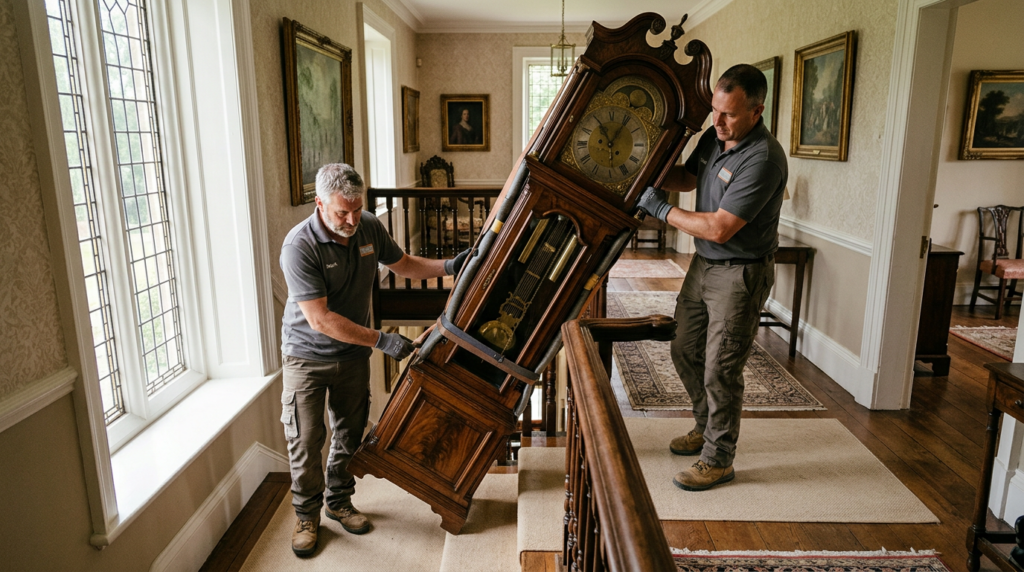
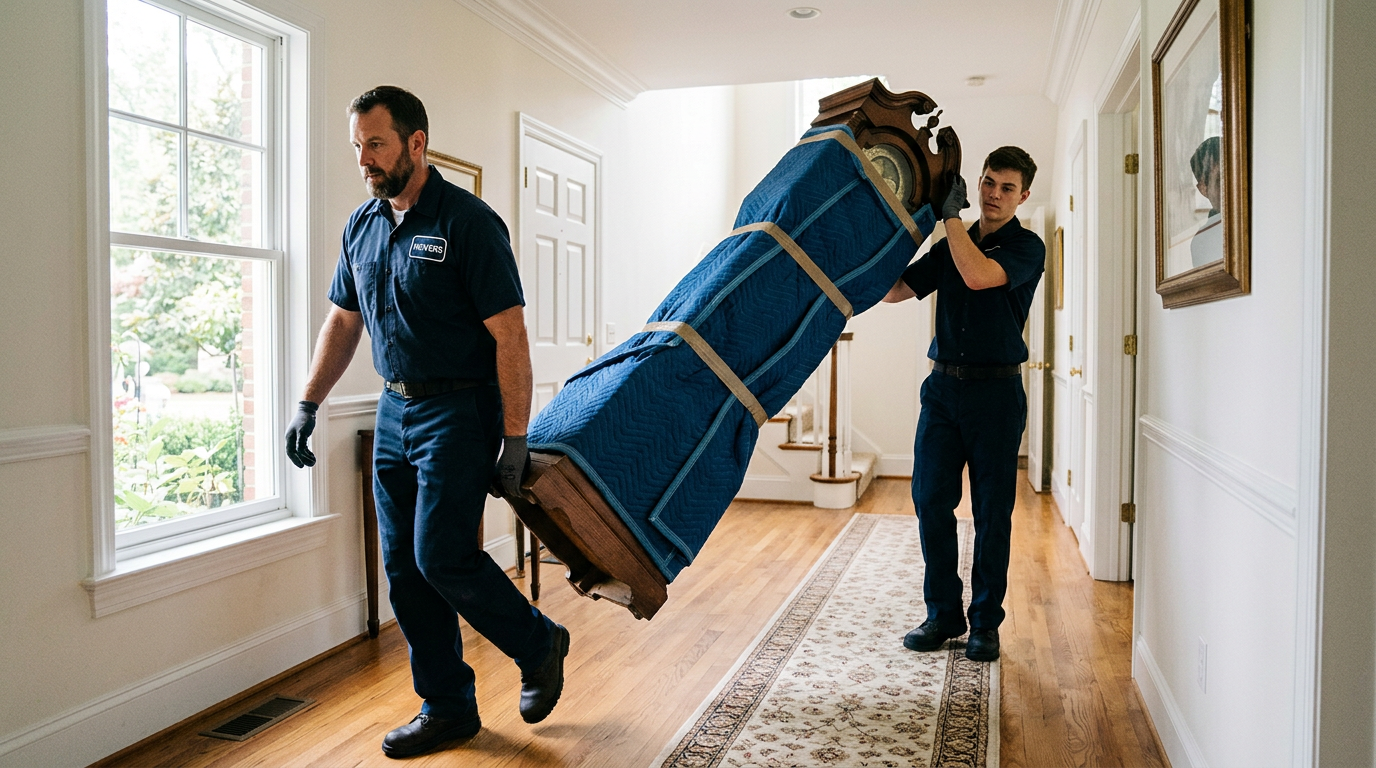
Moving a grandfather clock differs from moving a bookcase because the piece is both a tall wooden case and a precision instrument. Trained grandfather clock movers start by removing or securing the pendulum, the drive weights, the chains or cables, and any removable shelves and glass panels, because loose parts can swing, scratch, or snap once the case tilts. They then wrap glass panels, wood corners, finials, and doors in soft protective materials such as moving blankets and foam, the same careful approach used when packing fragile items for moving. For families weighing their options, the same care that goes into hiring piano movers applies here, and a full-service provider such as Mike Hammer Moving treats the timepiece as an instrument, not just furniture, and follows the same discipline used for moving fragile items of any kind.
- Detach and bag the pendulum, the drive weights, the chains, and the cables, labeling each part so reassembly stays straightforward.
- Lift out removable shelves, glass panels, and the hood or bonnet, then wrap each piece in soft padding before it is crated.
- Cushion glass panels, wood corners, finials, and doors with moving blankets and foam to prevent chips, cracks, and scratched glass.
- Measure hallways, stairs, doorways, and truck clearance in advance, because a case that commonly stands 6 to 8 feet tall needs a clear, upright path.
- Keep the clock upright and level during transport, since the movement is built to keep time within only a few degrees of swing.
- Plan the route and loading order the way crews handle other bulky items, strapping the case so it cannot shift in transit.
Rule of Thumb
- Treat a grandfather clock as an instrument first and furniture second. Grandfather clock movers protect the movement by removing the pendulum and weights, padding the glass and corners, and confirming a clear upright path, because a case can stand 6 to 8 feet tall and even a small bump can put the clock out of beat.
|
Clock Component |
Documented Measurement |
Why It Complicates the Move |
Handling Step |
|---|---|---|---|
|
Case height |
The anchor escapement allowed a much longer, heavier pendulum and a correspondingly tall case ( Headrick, IEEE Control Systems) |
A tall, top-heavy case will not clear low doorways or truck openings if it is tilted |
Measure hallways, stairs, doorways, and truck access before lifting |
|
Seconds pendulum |
A 2-second pendulum swing period is 0.994 m ( NPL seconds pendulum report) |
A long, thin rod can bend or swing loose if it is left hanging during transport |
Remove the pendulum and wrap it separately in soft padding |
|
Escapement swing |
Anchor mechanism reduces the swing to as little as 6° ( Headrick, IEEE Control Systems) |
The movement keeps time only within a narrow beat, so tilt or jolts disrupt it |
Keep the case upright and level and secure it against shifting |
|
Transport regulation |
Missouri requires oversize permits for loads over legal weight and size limits ( Mo DOT oversize permits) |
Larger household loads must follow state carrier permit rules before they roll |
Carriers confirm size limits and plan routes before hauling bigger loads |
When Should You Hire Specialist Movers?
Hire specialists when the clock is tall, antique, weight-driven, or glass-fronted, or when it is too heavy to lift without strain. Professional help also makes sense before stair moves, long carries, tight turns, or long-distance transport, because one loose pendulum or weight can damage the movement.
Start by inspecting the case. Does it have a removable hood, a glass door, a moon dial, or delicate carved trim? Any of these can crack or detach if the cabinet tilts or bumps a doorframe. Ask whether the grandfather clock movers you are considering have handled specialty furniture, clocks, pianos, or antiques before, and how they secure a pendulum and weights for the road. OSHA's loading and unloading guidance states that workers should be instructed in safe procedures appropriate to the material they handle, a standard that separates trained specialists from general labor.
At Mike Hammer Moving, our trained, uniformed crews evaluate these risk factors for senior moving services and family relocations across Kansas City, KS, and Kansas City, MO, and our moving long distance guide walks through interstate transport to all 50 states. If your move includes clocks, antiques, or other irreplaceable pieces, see what specialty moving involves.
Quick Facts
- 1987 – Family-owned and operated since
- 45 – Trained, uniformed team members
- 12 – Company-owned trucks with direct, no-shared-load transport
- 50 – States covered for local and long-distance service
- 100% – Satisfaction guarantee
Ready for Careful Clock Moving?
Choose grandfather clock movers with specialty-item experience, and when requesting an estimate, share the clock's size, access path, stairs, and destination details, then ask about packing support for fragile glass, wood trim, pendulum parts, and weights. Mike Hammer Moving, family-owned since 1987, guarantees 100% satisfaction, so contact our team to reserve your date.
What Do People Ask Before Hiring Movers for a Grandfather Clock?
Most families ask the same practical questions before hiring grandfather clock movers: what information to gather, which services are included, and how the clock will keep time afterward. Having short, clear answers ready removes the guesswork. The questions below cover preparation, service details, and what to expect once your tall case clock is back in place.
What information should I have ready before requesting a moving quote?
Measure the case height and width, note an estimated weight, and record the clock's approximate age and maker if you know it. Clear photos of the full case, the dial, and any existing damage help the crew judge handling needs and access through doors and stairways. Sharing these details up front lets a mover build a more accurate estimate, which you can start through a free quote request.
Do movers handle packing, loading, transport, and placement, or are those separate services?
Treat packing, loading, transport, and final placement as separate line items and confirm each one in writing. Some crews pack and crate the case but leave placement to you, while a full-service provider such as Mike Hammer Moving can handle the piece from crating through placement. Loading is the most physical step, and trained crews follow safe procedures matched to the material they handle, as outlined in OSHA loading and unloading guidance. Ask whether the team also levels and positions the clock in its new room.
Why does my grandfather clock keep poor time right after the move?
A tall case clock that ran perfectly at home may gain or lose minutes after a move, and that is usually normal. The case needs to settle on a level surface before the pendulum swings true. Give the clock a day or two sitting level and in its final spot before judging timekeeping accuracy. If it still runs poorly once leveled, a clock specialist can fine-tune the beat.
Can I move a tall case clock myself, or should I hire help?
You can move a smaller clock yourself, but a full-size grandfather clock is tall, top-heavy, and fragile, so professional help lowers the risk of cracked cases, broken glass, and movement damage. Heavy specialty items demand the same careful technique, which is why many families use a dedicated piano moving crew for the heaviest pieces. Proper equipment and a practiced method matter more than raw muscle on a project like this.
{
“@context”: “https://schema.org”,
“@type”: “FAQPage”,
“mainEntity”: [
{
“@type”: “Question”,
“name”: “What information should I have ready before requesting a moving quote?”,
“acceptedAnswer”: {
“@type”: “Answer”,
“text”: “Measure the case height and width, note an estimated weight, and record the clock’s approximate age and maker if you know it. Clear photos of the full case, the dial, and any existing damage help the crew judge handling needs and access through doors and stairways. Sharing these details up front lets a mover build a more accurate estimate, which you can start through a free quote request.”
}
},
{
“@type”: “Question”,
“name”: “Do movers handle packing, loading, transport, and placement, or are those separate services?”,
“acceptedAnswer”: {
“@type”: “Answer”,
“text”: “Treat packing, loading, transport, and final placement as separate line items and confirm each one in writing. Some crews pack and crate the case but leave placement to you, while a full-service provider such as Mike Hammer Moving can handle the piece from crating through placement. Loading is the most physical step, and trained crews follow safe procedures matched to the material they handle, as outlined in OSHA loading and unloading guidance. Ask whether the team also levels and positions the clock in its new room.”
}
},
{
“@type”: “Question”,
“name”: “Why does my grandfather clock keep poor time right after the move?”,
“acceptedAnswer”: {
“@type”: “Answer”,
“text”: “A tall case clock that ran perfectly at home may gain or lose minutes after a move, and that is usually normal. The case needs to settle on a level surface before the pendulum swings true. Give the clock a day or two sitting level and in its final spot before judging timekeeping accuracy. If it still runs poorly once leveled, a clock specialist can fine-tune the beat.”
}
},
{
“@type”: “Question”,
“name”: “Can I move a tall case clock myself, or should I hire help?”,
“acceptedAnswer”: {
“@type”: “Answer”,
“text”: “You can move a smaller clock yourself, but a full-size grandfather clock is tall, top-heavy, and fragile, so professional help lowers the risk of cracked cases, broken glass, and movement damage. Heavy specialty items demand the same careful technique, which is why many families use a dedicated piano moving crew for the heaviest pieces. Proper equipment and a practiced method matter more than raw muscle on a project like this.”
}
}
]
}